AuthorWrite something about yourself. No need to be fancy, just an overview. ArchivesCategories |
Back to Blog
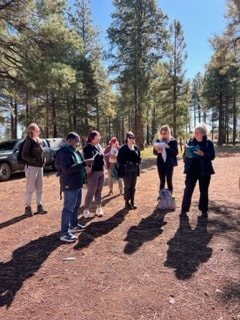
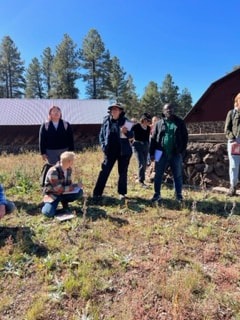
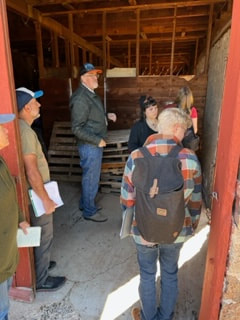
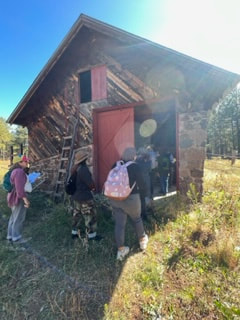 Mark showing us the historic buildings onsite. Mark showing us the historic buildings onsite. The best classes (in my humble opinion) are those that involve some level of hands-on, experiential learning. For our Introduction to Permaculture class we are getting the ultimate submersion - an opportunity to imagine the permaculture potential of the McAllister Ranch Site which is a city owned property, just west of the Flagstaff, AZ on Route 66. The McAllister Ranch Site is a small sliver of what was once a massive ranch on the outskirts of Flagstaff, stretching from its current location all the way to the arboretum. Divided and subdivided over the years, as Flagstaff has changed from the days when camels were a popular form of transportation to the advent of the railroad to the construction of Route 66, the McAllister Ranch is now a small plot, intersected by the FUTS (Flagstaff Urban Trail System). It consists of a couple of well preserved, open barns and one historical, boarded up house, which Mark Reavis, the Flagstaff Heritage Preservation Officer, informs us is much more likely to be broken into than its unfortified counterparts. Mark Reavis and Summer White, the city’s Sustainability Coordinator, have met us onsite to share more about the property, and the vision. For me, Summer is a familiar face. We see each other often at urban farming and food events around town. Mark is a new character and he immediately jumps into showing us the lay of the land, walking us by the different historic buildings and asking us what we think of them - of their preservation and their potential. He informs us that preservation does not necessarily mean keeping everything exactly the way it has always been. Things can shift and change to meet a new purpose - as long as we are considering and honoring the historic value of the ranch. As we follow along I think about how that meshed well with permaculture values, since we are encouraged to use materials that are already onsite and local. Doesn’t get much more local than repurposing old buildings and materials! There were a number of things of interest in the site - the old cistern that is still passively collecting water, a large berm running through the property - its purpose unclear, the number of FUTS trail users we observed during our two hours there, the compacted and degraded soil underfoot. But perhaps most interesting was the opportunity to sit down with Summer and chat with her about the hopes and dreams for the project. Summer clarified that there are a couple of hopes for how the site can support community needs:
What I gathered from our conversation is that similar to the city’s other incubator garden, Townsite Urban Farm, this site will also ultimately require a land steward who will be chosen through a Request for Proposal (RFP) process. As a big picture thinker this clarified, for me, the role of our class and final project - instead of the final class product being a static, specific site design I see now the value of offering recommendations and resources. What we create and imagine in the class will inform the RFP more than it will inform the ultimate site design and use, since that will be up to the farmer(s) that eventually steward the site. Therefore I see the following things being incredibly useful for the RFP design process:
My biggest takeaway from the field trip was how important it is that we frame our class project through the bigger picture lens. We need to understand that our classwork is preparation for the next step and is ultimately a recommendation. Providing a variety of options and creating redundancy in our planning would be wise if we hope to truly seed the start of a community garden at McAllister Ranch. I look forward to seeing what we can come up with and where it goes next! Excitedly yours - Lindsey Falkenburg
0 Comments
|
 RSS Feed